
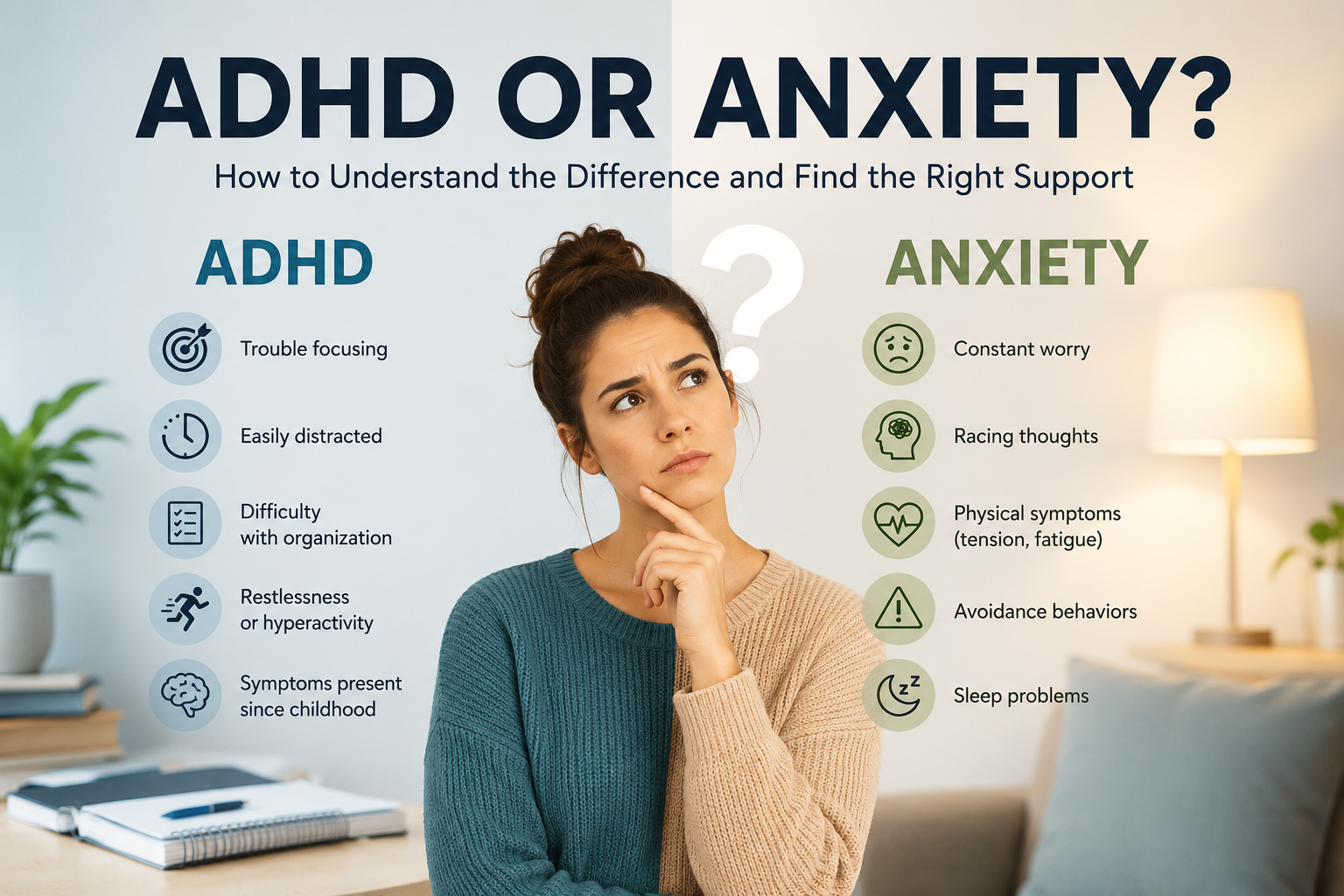
Is It ADHD or Anxiety? Understanding the Differences
Understanding why both conditions can affect focus, organization, motivation, restlessness, sleep, and emotional well-being.

This article has been reviewed for educational and clinical accuracy and discusses overlapping symptoms, differential diagnosis, and treatment considerations for ADHD and anxiety.
Difficulty concentrating does not automatically mean ADHD. Likewise, procrastination, restlessness, forgetfulness, and poor sleep do not always result from anxiety. ADHD and anxiety can produce similar day-to-day problems, even though the underlying reasons may be different.
Distinguishing between them is important because treatment should address the actual source of impairment. Some people have ADHD, some have an anxiety disorder, and many experience both.
Key Takeaway
ADHD usually reflects a persistent developmental pattern of inattention and/or hyperactivity-impulsivity that begins in childhood. Anxiety-related concentration problems are more often connected to worry, fear, tension, avoidance, or mental preoccupation. A professional evaluation looks at the full timeline rather than a single symptom.
Why ADHD and Anxiety Are Easy to Confuse
Both conditions can interfere with attention, working memory, planning, motivation, and emotional regulation. A person with anxiety may lose focus because the mind is occupied by worry. A person with ADHD may lose focus because attention is difficult to regulate, especially during repetitive or low-interest tasks.
- • Difficulty concentrating
- • Procrastination and avoidance
- • Restlessness
- • Forgetfulness
- • Trouble completing tasks
- • Sleep difficulties
- • Irritability and emotional overwhelm
- • Reduced confidence after repeated struggles
What ADHD Commonly Looks Like
ADHD is a neurodevelopmental condition involving persistent inattention, hyperactivity, impulsivity, or a combination of these symptoms. In adults, hyperactivity may appear less as obvious running or climbing and more as internal restlessness, excessive talking, fidgeting, or difficulty slowing down.
- • Long-standing problems with organization
- • Frequently losing important items
- • Difficulty estimating time
- • Starting tasks but not finishing them
- • Becoming distracted by thoughts, sounds, or surroundings
- • Impulsive decisions or interruptions
- • Periods of intense focus on highly interesting activities
- • Symptoms that can be traced back to childhood
What Anxiety Commonly Looks Like
Anxiety disorders involve more than occasional stress. Worry or fear may be persistent, difficult to control, present across many situations, and associated with physical tension or avoidance.
- • Repeated “what if” thinking
- • Fear of mistakes, criticism, or negative outcomes
- • Avoiding situations that feel uncertain or threatening
- • Reassurance seeking
- • Muscle tension, headaches, or stomach discomfort
- • Trouble sleeping because the mind will not slow down
- • Difficulty concentrating because of worry
- • Panic symptoms in some individuals
ADHD vs. Anxiety: A Practical Comparison
| Area | More Suggestive of ADHD | More Suggestive of Anxiety |
|---|---|---|
| Attention | Distracted even when calm; focus varies with interest | Focus worsens when worry or fear is active |
| Timeline | Pattern usually begins in childhood | May begin after stress, trauma, or a later life change |
| Procrastination | Difficulty initiating, sequencing, or sustaining effort | Avoidance because of fear, perfectionism, or uncertainty |
| Restlessness | Chronic need for movement or stimulation | Physical tension or agitation linked to apprehension |
| Mistakes | Missed details due to inattention or impulsivity | Overchecking because mistakes feel threatening |
| Sleep | Delayed bedtime, inconsistent routines, or mental stimulation | Trouble sleeping because of worry or physical tension |
Can ADHD Cause Anxiety?
Repeated missed deadlines, forgotten responsibilities, academic struggles, work problems, or criticism can create secondary anxiety in someone with ADHD. The person may begin worrying intensely because previous experiences have taught them that important tasks are easy to overlook or delay.
Can Anxiety Look Like ADHD?
Yes. Persistent worry consumes mental resources. Someone may appear forgetful, distracted, disorganized, or unable to complete tasks because attention is repeatedly pulled toward feared outcomes. When anxiety improves, these attention problems may also improve.
Why Childhood History Matters
ADHD symptoms begin during childhood, although they may not be recognized until adulthood. A clinician may ask about school performance, report cards, unfinished assignments, behavior, organization, family observations, and whether symptoms occurred in more than one setting.
Other Conditions That May Affect Focus
A thorough evaluation also considers other possible explanations:
- • Depression
- • Trauma-related conditions
- • Bipolar disorder
- • Sleep disorders or chronic sleep deprivation
- • Substance use
- • Medication side effects
- • Thyroid or other medical conditions
- • Learning disorders
How a Psychiatric Evaluation Helps
There is no single online quiz that can reliably distinguish ADHD from anxiety. A comprehensive evaluation considers symptom onset, severity, frequency, triggers, developmental history, medical history, sleep, substance use, family history, and functional impairment.
- ✓ Clinical interview and symptom timeline
- ✓ Developmental and childhood history
- ✓ Review of work, school, and relationship functioning
- ✓ Standardized screening tools when appropriate
- ✓ Assessment for co-occurring conditions
- ✓ Individualized treatment planning
Treatment When ADHD and Anxiety Occur Together
Treatment should be individualized. Depending on which symptoms are most impairing, care may include psychotherapy, medication, behavioral strategies, sleep support, organizational systems, or treatment of another contributing condition.
Medication decisions require careful monitoring. Some people feel less anxious when ADHD symptoms become more manageable, while others may need treatment directed specifically at anxiety. The correct sequence and combination of treatments differs from one person to another.
Frequently Asked Questions
Can anxiety look like ADHD?
Yes. Anxiety may impair concentration, memory, sleep, and task completion. The key question is whether attention problems are primarily driven by worry or reflect a broader, long-standing developmental pattern.
Can someone have both ADHD and anxiety?
Yes. The conditions can occur together, and each may intensify the effects of the other. A complete assessment is important because treating only one condition may leave significant symptoms unresolved.
Does ADHD medication make anxiety worse?
Responses vary. Medication may improve functioning and reduce secondary anxiety for some people, while others may experience increased nervousness or physical activation. Treatment should be prescribed and monitored by a qualified clinician.
Should adults be evaluated even if they did well in school?
Yes. Strong intelligence, structure, family support, or extensive compensatory strategies may hide ADHD symptoms. Evaluation focuses on the full history and the effort required to maintain functioning, not grades alone.
ADHD and Anxiety Evaluation in Irvine
Spectrum Psychiatry provides individualized psychiatric evaluations for adults and adolescents experiencing attention problems, anxiety, restlessness, procrastination, emotional overwhelm, sleep difficulties, or uncertainty about the cause of their symptoms.
- ✓ Comprehensive psychiatric evaluations
- ✓ ADHD and anxiety assessment
- ✓ Review of overlapping and co-occurring conditions
- ✓ Medication management when appropriate
- ✓ Individualized treatment planning
- ✓ Serving Irvine and Orange County
Medical disclaimer: This article is for general educational purposes and does not replace individualized medical or psychiatric evaluation, diagnosis, or treatment.