
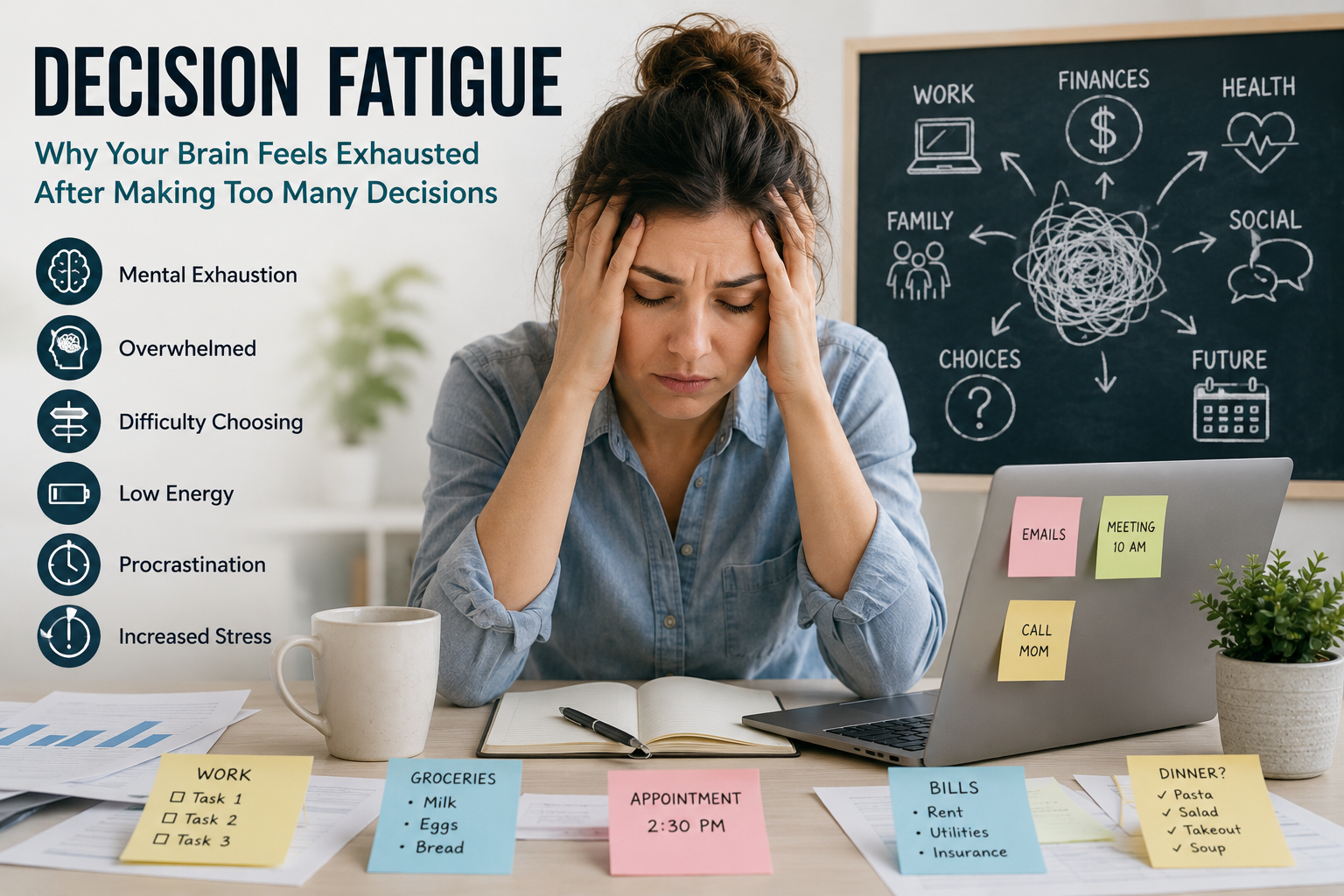
Decision Fatigue: Why Your Brain Feels Exhausted After Making Too Many Decisions
Decision fatigue happens when the brain becomes mentally exhausted after making too many choices. Some decisions are small, such as what to eat, what email to answer first, or which task to start. Others are more stressful, such as financial choices, parenting decisions, medical concerns, work problems, or relationship issues.
For many adults in Irvine, Orange County, and across California, daily life requires constant decision-making. Work demands, family responsibilities, school schedules, digital notifications, financial pressure, and health concerns can all create cognitive overload.
At Spectrum Psychiatry in Irvine, we often see patients who describe feeling mentally exhausted, overwhelmed, unfocused, irritable, or unable to make even simple choices. Decision fatigue may be connected to stress, anxiety, depression, ADHD symptoms, burnout, poor sleep, or emotional overload.
What Is Decision Fatigue?
Decision fatigue is the mental tiredness that can build up when a person has to make too many decisions over time. The brain has limited energy for attention, self-control, planning, and problem-solving. When that energy is used repeatedly without enough recovery, even ordinary choices can begin to feel difficult.
A person with decision fatigue may feel stuck, avoid choices, procrastinate, become impulsive, or feel emotionally drained. They may spend too much time thinking about small decisions, or they may make quick choices just to end the discomfort.
Common Signs of Decision Fatigue
- Feeling overwhelmed by simple choices
- Putting off decisions until the last minute
- Feeling mentally exhausted by the end of the day
- Making impulsive choices just to be done
- Difficulty prioritizing tasks
- Irritability or frustration when asked to decide
- Feeling stuck between options
- Loss of motivation after a busy day
- Difficulty focusing or completing tasks
- Feeling emotionally numb or burned out
These symptoms can affect work, school, parenting, relationships, and self-care. If decision fatigue is persistent or interfering with daily life, it may be helpful to look at the underlying mental health factors.
Why Modern Life Creates So Much Decision Fatigue
Modern life creates more decisions than many people realize. Smartphones, emails, calendars, online shopping, social media, work messages, health information, and family responsibilities all compete for attention. Even small digital choices can add up.
In busy communities like Irvine and Orange County, many people manage demanding careers, academic pressure, family schedules, and high expectations. Over time, the brain may begin to feel overloaded.
Decision fatigue is not a personal weakness. It is often a sign that the nervous system and attention system are carrying too much without enough recovery.
Decision Fatigue and Anxiety
Anxiety can make decision fatigue worse. When someone is anxious, they may worry about making the wrong choice, disappointing others, wasting time, or facing negative consequences. This can make even small decisions feel stressful.
Anxiety may also lead to overthinking. A person may replay options repeatedly, seek reassurance, or avoid deciding altogether. Over time, this can increase mental exhaustion.
Learn more about our anxiety treatment services at Spectrum Psychiatry in Irvine and Orange County.
Decision Fatigue and ADHD
Decision fatigue can be especially challenging for adults with ADHD. ADHD can affect executive functioning, which includes planning, organizing, prioritizing, starting tasks, and switching attention. When every task requires extra mental effort, choices can become exhausting.
Adults with ADHD may feel overwhelmed by open-ended tasks. They may know what needs to be done but struggle to decide where to start. This can lead to procrastination, stress, and guilt.
If decision fatigue is connected to distractibility, disorganization, poor follow-through, or lifelong attention challenges, an ADHD evaluation may be helpful.
You can learn more about ADHD treatment in Irvine.
Decision Fatigue and Depression
Depression can also make decision-making harder. Low energy, low motivation, poor concentration, guilt, hopelessness, and sleep problems can reduce the brain's ability to process choices clearly.
A person with depression may feel that every option is too difficult or that no choice will make a difference. This can create avoidance, emotional exhaustion, and loss of confidence.
Spectrum Psychiatry provides depression treatment in Irvine and Orange County for adults experiencing low mood, fatigue, loss of interest, and difficulty functioning.
Decision Fatigue vs. Burnout
Decision fatigue and burnout often overlap. Decision fatigue may appear after a day full of choices, while burnout is usually a longer-term state of emotional and physical exhaustion caused by chronic stress.
If decision fatigue happens occasionally, rest and better routines may help. If it becomes constant, or if you feel emotionally detached, cynical, exhausted, or unable to recover, burnout or depression may also be present.
Read more about burnout vs. depression.
How Decision Fatigue Affects Relationships
Decision fatigue can affect relationships when one person feels too overwhelmed to make plans, answer questions, or participate in daily choices. Partners, family members, or coworkers may misinterpret this as laziness, indifference, or avoidance.
In reality, the person may feel mentally overloaded. They may care deeply but lack the mental energy to choose, explain, or organize. This can create frustration on both sides.
Communication, shared planning, simplified routines, and professional support can help reduce the emotional impact of decision fatigue.
Practical Ways to Reduce Decision Fatigue
- Create simple morning and evening routines
- Plan meals or outfits ahead of time
- Use written lists instead of keeping everything in your head
- Limit non-essential choices during stressful periods
- Make important decisions earlier in the day when possible
- Turn off unnecessary notifications
- Break large decisions into smaller steps
- Set time limits for low-impact decisions
- Ask for help with planning when overwhelmed
- Prioritize sleep and recovery time
These strategies can help reduce cognitive overload. However, if decision fatigue is connected to anxiety, depression, ADHD, insomnia, trauma, or chronic stress, professional treatment may be important.
When to Seek Professional Help
It may be time to seek help if decision fatigue is affecting your work, relationships, sleep, mood, motivation, or ability to function. You do not need to wait until symptoms become severe.
- You feel mentally exhausted most days
- You avoid decisions because they feel overwhelming
- You feel anxious, depressed, or burned out
- You struggle with focus, organization, or follow-through
- Your sleep or energy is consistently poor
- You feel emotionally numb or disconnected
- Daily responsibilities feel harder than they should
Decision Fatigue Treatment in Irvine and Orange County
Spectrum Psychiatry provides personalized psychiatric care for adults in Irvine, Orange County, and nearby California communities. If decision fatigue is connected to anxiety, depression, ADHD symptoms, burnout, or sleep problems, a psychiatric evaluation can help identify the root causes.
Treatment may include medication management when appropriate, therapy recommendations, lifestyle strategies, sleep support, stress management, and treatment for underlying psychiatric conditions.
If you are searching for a psychiatrist in Irvine, CA, Spectrum Psychiatry can help you better understand how decision fatigue may be connected to your mental health.
Related Articles

This article has been medically reviewed by Cuneyt Tegin to support accuracy, clarity, and alignment with current mental health education standards.
Last reviewed: June 2026
Mental Health Support in Irvine
If decision fatigue, anxiety, depression, ADHD symptoms, or burnout are affecting your daily life, Spectrum Psychiatry can help you explore personalized treatment options.
Contact Spectrum Psychiatry