
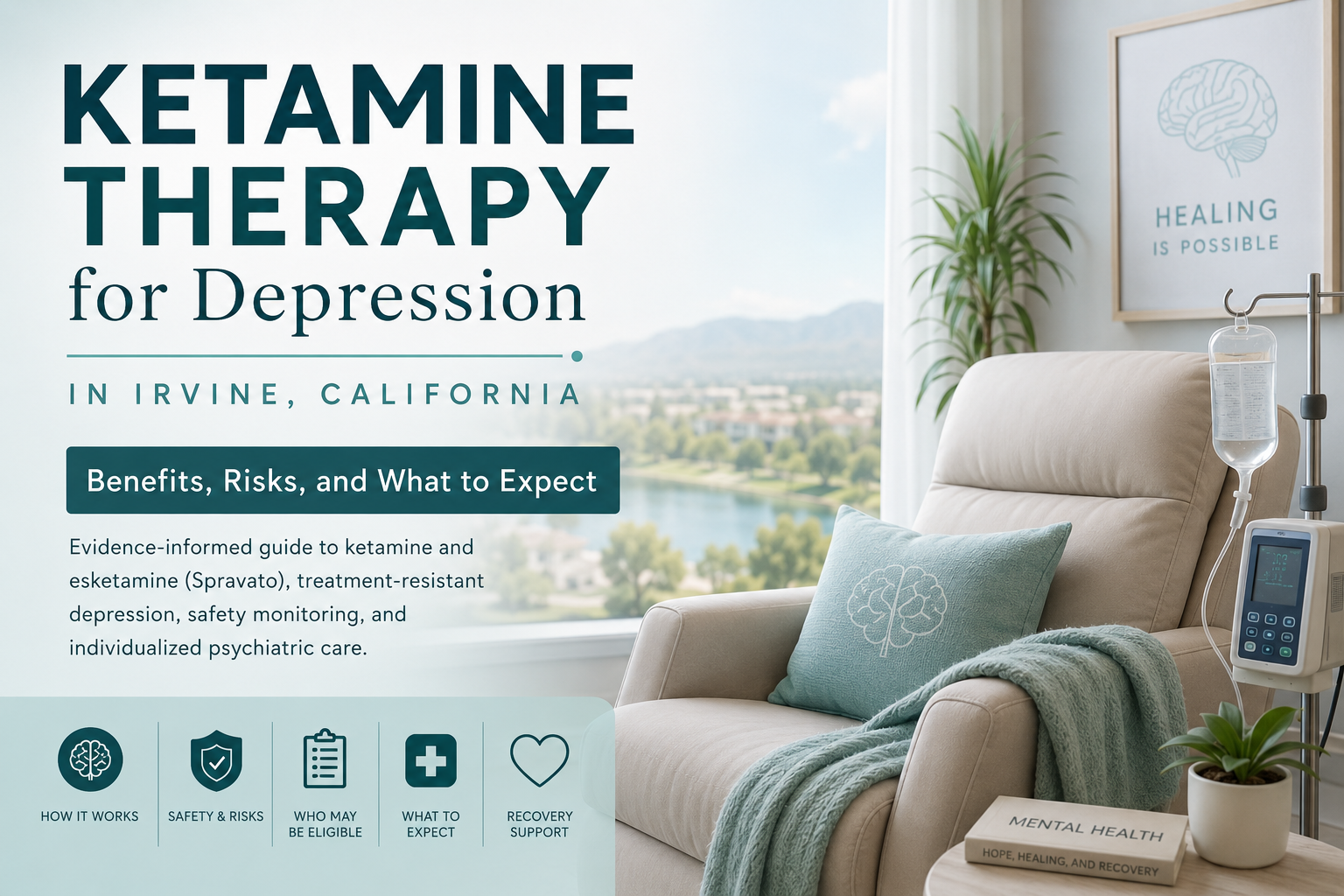
Ketamine Therapy for Depression in Irvine, California: Benefits, Risks, and What to Expect
Understanding ketamine, esketamine, Spravato, treatment-resistant depression, safety monitoring, and advanced psychiatric treatment options.

This article has been reviewed for educational and clinical accuracy and discusses ketamine, esketamine, Spravato, treatment-resistant depression, eligibility, risks, monitoring, and individualized psychiatric evaluation.
Important Treatment Distinction
Ketamine and esketamine are related but are not interchangeable. Ketamine is FDA-approved as an anesthetic and may be used off-label for psychiatric conditions after individualized medical assessment.
Esketamine nasal spray, sold under the brand name Spravato, has specific FDA-approved psychiatric indications and must be administered in a certified healthcare setting with monitoring.
Depression can interfere with mood, motivation, concentration, sleep, appetite, relationships, work, school, and the ability to complete everyday responsibilities. For many patients, psychotherapy, antidepressant medication, lifestyle changes, or a combination of treatments leads to meaningful improvement.
Some people, however, continue to experience significant symptoms despite receiving appropriate treatment. This is often described as treatment-resistant depression. Ketamine-based treatments have received increasing attention because they work through different brain pathways than traditional antidepressants.
These treatments are not appropriate for everyone and do not guarantee recovery. A comprehensive psychiatric and medical evaluation is necessary to determine whether ketamine, esketamine, or another treatment option may be appropriate.
Key Takeaway
Ketamine-based treatment is not a first-line solution for every person with depression. Eligibility depends on diagnosis, previous treatment response, medical history, cardiovascular health, substance use history, psychiatric symptoms, medication interactions, and the ability to complete required monitoring.
What Is Ketamine?
Ketamine is a medication that has been used in medical settings for anesthesia and procedural sedation. Unlike traditional antidepressants that primarily affect serotonin, norepinephrine, or dopamine systems, ketamine acts mainly through the brain's glutamate system.
In psychiatric care, lower doses of ketamine may be considered off-label for certain patients with severe or treatment-resistant depression. Off-label use means that a licensed clinician prescribes an FDA-approved medication for a purpose, dose, or route that is not included in its official FDA approval.
Off-label prescribing is common in medicine, but it still requires appropriate clinical judgment, informed consent, risk assessment, monitoring, and discussion of alternative treatments.
What Is Esketamine?
Esketamine is one part, or enantiomer, of the ketamine molecule. It is available as the prescription nasal spray Spravato. Esketamine is not the same product as intravenous ketamine, compounded ketamine lozenges, or ketamine injections used off-label in other settings.
Spravato has FDA-approved psychiatric indications for adults, including treatment-resistant depression. It is administered under direct observation in a certified healthcare setting rather than being taken home for unsupervised use.
Patients are monitored after each treatment because sedation, dissociation, respiratory depression, increased blood pressure, impaired judgment, and other effects may occur.
Ketamine vs. Esketamine: What Is the Difference?
| Area | Ketamine | Esketamine / Spravato |
|---|---|---|
| FDA status | Approved as an anesthetic; psychiatric use is off-label | FDA-approved for specific adult depressive conditions |
| Common psychiatric route | May be administered by IV, IM, or another prescribed route depending on the clinical setting | Nasal spray administered in a certified healthcare setting |
| Home use | Depends on the formulation and clinician, although unsupervised compounded products raise important safety concerns | Not dispensed for unsupervised home administration |
| Monitoring | Monitoring requirements depend on route, dose, patient risk, and treatment setting | Required observation and monitoring after each dose |
| Insurance coverage | Often limited because psychiatric use is off-label | Coverage varies and may require prior authorization |
How Does Ketamine Affect the Brain?
Ketamine primarily affects glutamate, one of the brain's most important chemical messengers. It interacts with N-methyl-D-aspartate receptors, commonly called NMDA receptors, and may influence other signaling pathways associated with synaptic communication and neuroplasticity.
Neuroplasticity refers to the brain's ability to create, strengthen, and reorganize connections. Researchers believe that changes in glutamate signaling and synaptic function may help explain why some patients experience antidepressant effects more quickly than they would with traditional oral antidepressants.
The exact antidepressant mechanism remains complex and is still being studied. A rapid biological effect does not eliminate the need for continued psychiatric care, psychotherapy, medication review, or relapse-prevention planning.
What Is Treatment-Resistant Depression?
Treatment-resistant depression generally describes major depressive disorder that has not improved adequately after appropriate antidepressant treatment attempts.
Before concluding that depression is treatment-resistant, a psychiatrist should review whether previous medications were taken at appropriate doses and for sufficient periods, whether doses were missed, whether side effects limited treatment, and whether psychotherapy or other interventions were adequately tried.
A careful evaluation also considers whether symptoms may be affected by:
- • Bipolar disorder or mood instability
- • Anxiety disorders
- • PTSD or unresolved trauma
- • ADHD
- • Substance use
- • Sleep disorders
- • Chronic pain
- • Thyroid or other medical conditions
- • Medication interactions or side effects
- • Severe psychosocial stress
Who May Be Considered for Ketamine-Based Treatment?
Ketamine-based treatment may be considered for certain adults with significant depressive symptoms who have not improved adequately with standard approaches. Eligibility depends on the specific treatment, diagnosis, clinical history, and treatment setting.
A psychiatrist may consider factors such as:
- ✓ A confirmed depressive disorder diagnosis
- ✓ Severity and duration of symptoms
- ✓ Previous antidepressant treatment attempts
- ✓ Previous psychotherapy and other interventions
- ✓ Current level of functioning
- ✓ Medical and cardiovascular history
- ✓ Current medications and possible interactions
- ✓ Substance use and addiction risk
- ✓ Psychosis, mania, or severe dissociative symptoms
- ✓ Ability to attend treatment and monitoring appointments
- ✓ Availability of transportation after treatment
Who May Not Be an Appropriate Candidate?
A diagnosis of depression does not automatically make someone a candidate. Certain medical or psychiatric factors may increase risk, require additional evaluation, or make another treatment more appropriate.
- • Uncontrolled high blood pressure
- • Certain serious cardiovascular conditions
- • Aneurysmal vascular disease or other vascular risks
- • Active psychosis
- • Uncontrolled mania
- • Significant current substance misuse
- • Previous severe reaction to ketamine or esketamine
- • Pregnancy or breastfeeding concerns
- • Inability to complete required monitoring
- • Inability to arrange safe transportation after treatment
This list is not complete. Eligibility must be determined through an individualized psychiatric and medical assessment.
Ketamine-Based Treatment and Bipolar Depression
Depressive symptoms can occur in both major depressive disorder and bipolar disorder. Distinguishing between them is essential because treatment decisions and the risk of mood activation may differ.
Patients with a history of unusually elevated mood, reduced need for sleep, impulsive behavior, racing thoughts, increased energy, or previous manic symptoms should discuss these experiences during the psychiatric evaluation.
Ketamine and Suicidal Thoughts
Some ketamine-based treatments have been studied for rapid reduction of severe depressive symptoms and suicidal thinking. However, temporary symptom improvement does not replace a complete safety plan, ongoing treatment, hospitalization when necessary, or emergency care.
Is There an Immediate Safety Risk?
Call 911 or go to the nearest emergency department for an immediate risk of suicide, a suicide attempt, overdose, severe confusion, inability to remain conscious, breathing difficulty, or danger to the patient or others.
Routine outpatient psychiatric and ketamine consultations are not substitutes for emergency care.
How Is Ketamine Administered?
Ketamine may be administered through different routes depending on the clinical purpose, formulation, provider, and treatment setting. Psychiatric protocols vary, and not every route has the same evidence, regulation, absorption, or monitoring requirements.
Intravenous Ketamine
Intravenous ketamine is delivered through a vein in a monitored medical setting. The dose used in psychiatric care is generally lower than doses used for anesthesia.
Intramuscular Ketamine
Intramuscular ketamine is delivered by injection into a muscle. Absorption and treatment protocols differ from intravenous administration.
Esketamine Nasal Spray
Spravato is administered by the patient as a nasal spray under the direct observation of a healthcare professional in a certified setting. The medication is not taken home for independent use.
Compounded Oral or Sublingual Ketamine
Some practices prescribe compounded oral tablets, liquids, or sublingual lozenges. Compounded ketamine products are not FDA-approved for psychiatric disorders, and their quality, absorption, dosing consistency, supervision, and safety protocols may differ. Patients should understand these limitations before treatment.
What Happens Before Treatment?
Ketamine-based treatment should begin with a comprehensive psychiatric and medical evaluation. The purpose of this assessment is to confirm the diagnosis, review previous treatments, identify safety concerns, and determine whether another intervention may be more appropriate.
The evaluation may include:
- ✓ Current depressive symptoms and severity
- ✓ Previous antidepressant medications and responses
- ✓ Previous psychotherapy and other treatments
- ✓ History of mania, psychosis, or dissociation
- ✓ Suicide risk and current safety concerns
- ✓ Blood pressure and cardiovascular history
- ✓ Substance use and addiction history
- ✓ Current medications and supplements
- ✓ Pregnancy or breastfeeding considerations
- ✓ Transportation and post-treatment support
Additional medical records, laboratory testing, primary care coordination, or specialist consultation may be recommended depending on the patient's history.
What Happens on a Treatment Day?
The treatment-day process depends on whether the patient receives intravenous ketamine, intramuscular ketamine, or esketamine nasal spray. Each clinic may have specific protocols, but monitored treatment generally includes a pre-treatment check, medication administration, observation, and discharge instructions.
A treatment visit may include:
- • Confirmation of current medications and health changes
- • Blood pressure and vital-sign assessment
- • Review of food and drink instructions
- • Medication administration under supervision
- • Monitoring for sedation or dissociation
- • Repeated blood pressure checks when appropriate
- • Assessment before the patient is released
- • Transportation home by a responsible adult
Patients should follow the treatment center's instructions regarding food, liquids, medications, driving, work, exercise, and other activities before and after treatment.
What Does Ketamine Treatment Feel Like?
Experiences vary. Some patients report relaxation, altered sensory perception, a feeling of distance from the body, changes in time perception, or temporary difficulty concentrating. Others may feel anxious, dizzy, nauseated, emotionally uncomfortable, or heavily sedated.
Dissociation refers to a temporary sense of detachment from thoughts, feelings, surroundings, or the body. Although some patients find the experience neutral or calming, others may find it distressing.
Patients should tell the clinical team immediately if they experience severe fear, chest pain, breathing difficulty, confusion, intense agitation, or another unexpected symptom.
How Long Does Monitoring Last?
Monitoring time depends on the medication, route, dose, clinical response, and treatment protocol. Spravato treatment requires observation in the certified healthcare setting after each dose.
A patient should not leave until the healthcare professional determines that the person is clinically stable. A longer observation period may be required if sedation, dissociation, blood pressure elevation, nausea, confusion, or other symptoms remain significant.
Can You Drive After Ketamine or Spravato?
Patients should not drive themselves home after treatment. Ketamine and esketamine may impair attention, reaction time, coordination, judgment, and perception even after the most noticeable effects begin to improve.
Patients should arrange transportation in advance and follow the treatment center's instructions about when driving, operating machinery, working, or making important decisions may be resumed.
Possible Side Effects
Side effects vary according to the medication, dose, route, treatment frequency, other medications, and individual medical history.
Possible effects may include:
- • Dissociation or altered perception
- • Sedation or sleepiness
- • Dizziness or lightheadedness
- • Nausea or vomiting
- • Increased blood pressure
- • Headache
- • Anxiety or temporary emotional distress
- • Impaired coordination
- • Reduced attention or concentration
- • Unusual taste with nasal administration
- • Fatigue after treatment
Serious reactions are less common but require immediate clinical attention. Patients should discuss all potential risks before treatment and report new or worsening symptoms promptly.
Blood Pressure and Cardiovascular Monitoring
Ketamine and esketamine may temporarily increase blood pressure and heart rate. This is one reason cardiovascular history and baseline blood pressure are reviewed before treatment.
Patients with uncontrolled hypertension, certain vascular conditions, recent cardiovascular events, or other significant medical risks may require additional evaluation or may not be appropriate candidates.
Is Ketamine Addictive?
Ketamine has misuse and dependence potential. Recreational use, escalating doses, frequent unsupervised administration, or using the medication outside a structured treatment plan can increase risk.
A history of substance use disorder does not automatically exclude every patient, but it requires careful assessment. Clinicians may review current substance use, previous addiction treatment, cravings, impulse control, recovery stability, and access to unsupervised medication.
Treatment should include clear boundaries, monitoring, documented treatment goals, and regular reassessment of benefits and risks.
Risks of Unsupervised or At-Home Ketamine
Unsupervised use can increase the risk of excessive sedation, dissociation, falls, impaired judgment, medication misuse, breathing problems, blood pressure changes, interactions with alcohol or other sedatives, and delayed emergency treatment.
Patients considering compounded or at-home ketamine should ask about the evidence supporting the route, product quality, prescribing safeguards, emergency procedures, monitoring, and how treatment effectiveness will be evaluated.
Avoid Combining Sedating Substances
Alcohol, opioids, benzodiazepines, sleep medications, cannabis, and other sedating substances may increase impairment or medical risk. Patients should disclose all substance use and follow individualized instructions from the treating clinician.
How Quickly Can Symptoms Improve?
Some patients report improvement within hours or days, which is faster than the typical response timeline for many traditional antidepressants. Other patients improve gradually, experience only partial benefit, or do not respond.
Rapid symptom change should not be interpreted as a guaranteed or permanent recovery. Continued psychiatric monitoring is needed to assess durability, recurrence, side effects, and whether the overall treatment plan remains appropriate.
How Many Treatments Are Needed?
Treatment schedules vary according to the medication, protocol, diagnosis, symptom response, and tolerability. Some protocols begin with a more frequent induction phase followed by less frequent maintenance treatment.
There is no universal number of treatments that works for every patient. Continued treatment should depend on documented benefit, safety, patient goals, and periodic reassessment.
Does Improvement Last?
The duration of benefit varies. Some patients experience sustained improvement, while others notice symptoms returning after treatment is reduced or stopped.
Maintenance treatment, oral medication, psychotherapy, sleep support, behavioral changes, and treatment of co-occurring conditions may help support longer-term stability.
Ketamine vs. Traditional Antidepressants
| Area | Traditional Antidepressants | Ketamine-Based Treatment |
|---|---|---|
| Primary pathways | Often influence serotonin, norepinephrine, or dopamine | Primarily affects glutamate and NMDA-related signaling |
| Typical onset | Improvement may take several weeks | Some patients may experience improvement more rapidly |
| Administration | Usually taken orally at home | May require monitored IV, IM, or nasal administration |
| Common role | Often used as first-line treatment | Usually considered after inadequate response or for specific indications |
| Monitoring | Regular outpatient follow-up | Treatment-session observation and additional safety monitoring may be required |
Is Psychotherapy Still Important?
Ketamine-based treatment does not replace psychotherapy for many patients. Medication may reduce symptoms or create a period of increased flexibility, while therapy can address behavior, relationships, trauma, avoidance, negative thinking, coping skills, and relapse prevention.
The best combination depends on the diagnosis, treatment history, patient preferences, and clinical goals.
Questions to Ask a Ketamine or Spravato Provider
- • Which medication and route do you provide?
- • Is the treatment FDA-approved or off-label?
- • Who determines whether I am an appropriate candidate?
- • What monitoring is performed during treatment?
- • How are blood pressure and emergency concerns handled?
- • What training does the clinical team have?
- • How is treatment response measured?
- • What happens if I do not improve?
- • What are the risks of dependence or misuse?
- • Is psychotherapy available or recommended?
- • What costs may not be covered by insurance?
- • What transportation arrangements are required?
Frequently Asked Questions
Is ketamine approved by the FDA for depression?
Ketamine itself is FDA-approved as an anesthetic, not as a treatment for depression. Psychiatric use of ketamine is off-label. Esketamine nasal spray has specific FDA-approved psychiatric indications for adults.
What is Spravato?
Spravato is the brand name for esketamine nasal spray. It is administered under direct observation in a certified healthcare setting and requires post-dose monitoring.
Can Spravato be used at home?
No. Spravato is not dispensed directly to patients for independent home use. It is administered in a certified healthcare setting under professional supervision.
How fast can ketamine work for depression?
Some patients report improvement within hours or days, but response varies. Rapid improvement is not guaranteed, and benefits may not be permanent.
What are the most common side effects?
Possible effects include dissociation, sedation, dizziness, nausea, blood pressure elevation, headache, impaired coordination, anxiety, and temporary difficulty with attention or judgment.
Is ketamine addictive?
Ketamine has misuse and dependence potential. Structured medical treatment, careful patient selection, limited access, monitoring, and regular reassessment help reduce risk.
Can ketamine cure depression?
No treatment can guarantee a cure. Some patients experience meaningful symptom improvement, while others have partial benefit, no benefit, side effects, or later recurrence.
Can someone with bipolar depression receive ketamine?
Some patients with bipolar depression may be evaluated for advanced treatment, but careful assessment is essential because mood activation, mania, medication interactions, and diagnostic accuracy must be considered.
Does insurance cover ketamine or Spravato?
Coverage varies. Off-label ketamine may not be covered. Spravato coverage may require diagnosis verification, prior authorization, documentation of previous treatment attempts, and use of a participating certified provider.
Does Spectrum Psychiatry provide ketamine or Spravato treatment?
Spectrum Psychiatry provides individualized psychiatric evaluation and treatment planning. Patients should contact the practice directly to confirm whether ketamine-based or Spravato services are currently available. Referral or coordination with an appropriate treatment center may be recommended.
Advanced Depression Evaluation in Irvine
Spectrum Psychiatry provides comprehensive psychiatric evaluations for adults experiencing persistent depression, incomplete response to antidepressants, medication side effects, bipolar symptoms, anxiety, trauma-related concerns, sleep difficulties, or uncertainty about the next step in treatment.
Treatment recommendations are based on diagnosis, previous treatment response, medical history, safety, current symptoms, functioning, and individual goals.
- ✓ Comprehensive psychiatric evaluation
- ✓ Review of previous antidepressant treatments
- ✓ Treatment-resistant depression assessment
- ✓ Screening for bipolar disorder and co-occurring conditions
- ✓ Medication management when clinically appropriate
- ✓ Individualized treatment planning
- ✓ Referral or coordination for advanced treatments
- ✓ Serving Irvine and Orange County
Ketamine and Depression Care Across Orange County
Spectrum Psychiatry serves patients in Irvine, Newport Beach, Costa Mesa, Tustin, Lake Forest, Mission Viejo, Laguna Niguel, Huntington Beach, Santa Ana, Orange, and surrounding Orange County communities. Telepsychiatry may be available for psychiatric evaluation and follow-up when clinically appropriate and permitted by applicable requirements.
Final Thoughts
Ketamine-based treatment represents an important development in depression care, particularly for some adults who have not improved adequately with standard approaches.
It is not a universal solution, a guaranteed cure, or a replacement for careful diagnosis. The potential benefits must be weighed against cardiovascular risks, dissociation, sedation, misuse potential, cost, monitoring requirements, and the possibility that treatment may not work.
A comprehensive psychiatric evaluation can help determine whether ketamine, Spravato, another medication strategy, psychotherapy, or a different advanced treatment may be the most appropriate next step.
Medical disclaimer: This article is intended for general educational purposes and does not replace individualized medical or psychiatric evaluation, diagnosis, or treatment. Ketamine and esketamine have important risks and should only be used under appropriate clinical supervision. Contact Spectrum Psychiatry directly to verify which services are currently offered.
Emergency warning: Call 911 or go to the nearest emergency department for an immediate risk of suicide, a suicide attempt, overdose, loss of consciousness, breathing difficulty, severe confusion, chest pain, seizure, or danger to the patient or others. Spectrum Psychiatry is not an emergency response service.