
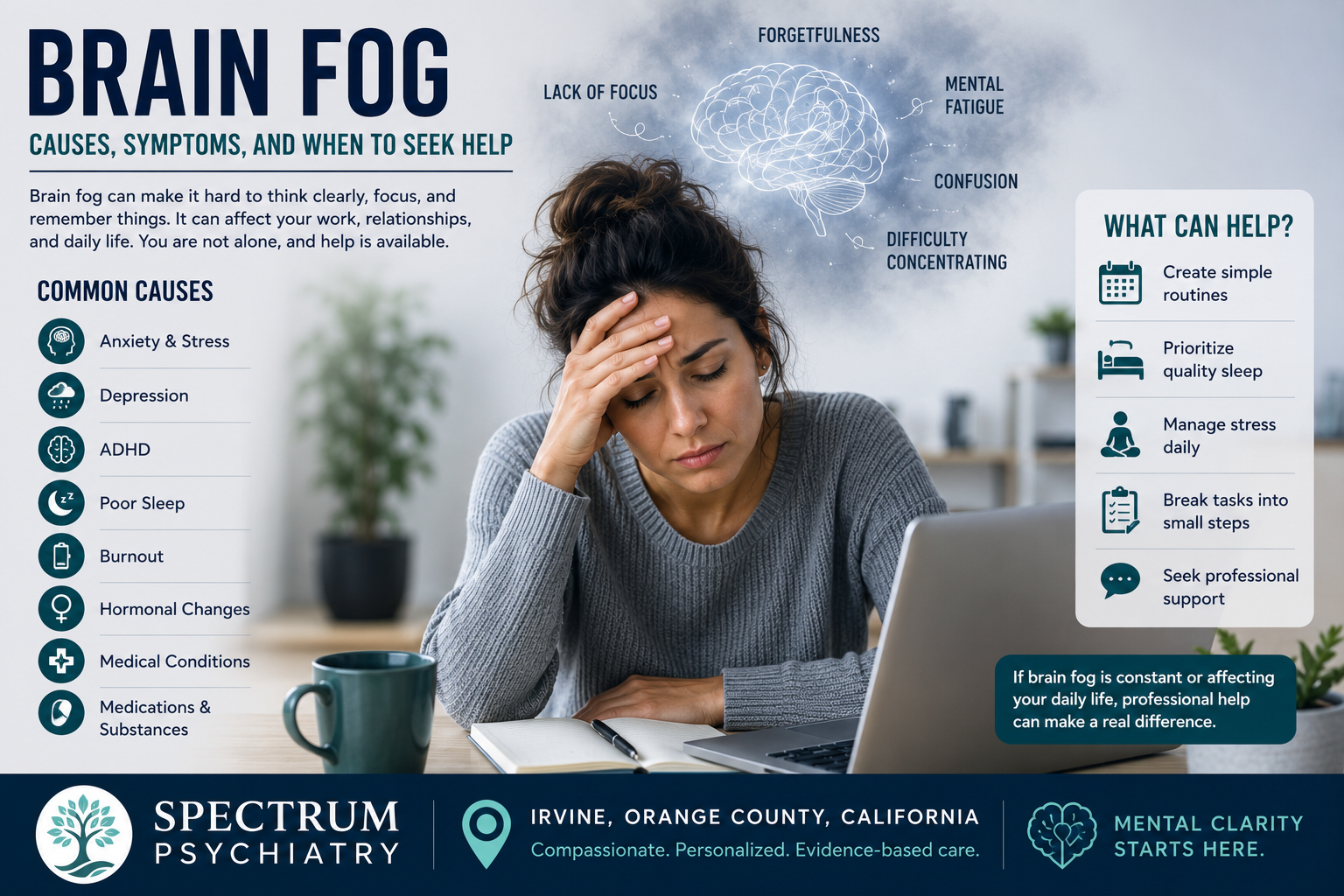
Brain Fog: Causes, Symptoms, and When to Seek Help
Brain fog can feel frustrating and confusing. You may forget why you walked into a room, reread the same sentence several times, or struggle to focus on work that used to feel manageable. Some people describe brain fog as mental cloudiness, slow thinking, poor concentration, forgetfulness, or feeling disconnected from their usual mental sharpness.
Brain fog is not a formal diagnosis by itself. Instead, it is a symptom that can be connected to many different causes, including anxiety, depression, ADHD, chronic stress, burnout, poor sleep, medication effects, medical conditions, and lifestyle factors.
At Spectrum Psychiatry in Irvine, Orange County, we help patients understand whether brain fog may be connected to mental health, sleep, stress, attention difficulties, mood symptoms, or other concerns. A careful evaluation can help identify what may be contributing to cognitive symptoms and what type of support may be helpful.
What Is Brain Fog?
Brain fog is a common phrase people use when their thinking feels unclear or slowed down. It may feel like your mind is working through a haze. You may know what you need to do, but starting or completing tasks feels harder than usual.
Some people experience brain fog occasionally during stressful weeks or after poor sleep. Others feel it every day. When brain fog becomes persistent, it can affect work performance, school, relationships, self-confidence, and daily functioning.
Common Symptoms of Brain Fog
- Difficulty concentrating
- Forgetfulness
- Slow thinking
- Trouble finding words
- Feeling mentally cloudy or disconnected
- Difficulty completing tasks
- Poor motivation
- Feeling overwhelmed by simple decisions
- Rereading information without absorbing it
- Mental fatigue after routine tasks
These symptoms can have many causes. That is why it is important to look at the full picture instead of assuming brain fog has only one explanation.
Brain Fog vs. Memory Loss
Brain fog and memory loss can feel similar, but they are not always the same. Brain fog often involves difficulty focusing, mental fatigue, or feeling slowed down. Memory loss may involve a clearer pattern of forgetting important information, getting lost, repeating questions, or losing track of familiar tasks.
If memory problems are sudden, severe, worsening, or connected to confusion, neurological symptoms, head injury, or major changes in functioning, medical evaluation is important. Brain fog can be connected to mental health, but physical health causes should also be considered when symptoms are significant.
Anxiety and Brain Fog
Anxiety is one of the most common mental health contributors to brain fog. When the mind is constantly scanning for danger, replaying conversations, worrying about the future, or preparing for worst-case scenarios, less mental energy is available for focus and memory.
A person with anxiety may feel distracted, forgetful, or unable to think clearly because their attention is pulled toward worry. This can be especially noticeable during work, school, conversations, or decision-making.
You can learn more about our anxiety treatment services in Irvine and Orange County.
Depression and Brain Fog
Depression can also affect concentration, memory, and mental clarity. People with depression may feel slowed down, tired, unmotivated, or unable to think as clearly as they used to. Even simple tasks may feel mentally heavy.
Brain fog related to depression may appear with low mood, loss of interest, guilt, hopelessness, sleep changes, appetite changes, and reduced energy. Some people continue functioning externally while privately struggling with mental fog and emotional exhaustion.
Spectrum Psychiatry provides depression treatment in Irvine and Orange County for adults experiencing mood symptoms, fatigue, low motivation, and cognitive symptoms such as brain fog.
ADHD and Brain Fog
ADHD can sometimes feel like brain fog, especially in adults. People with ADHD may struggle with working memory, task initiation, organization, distractibility, time management, and follow-through. This can create the feeling of being mentally scattered or cloudy.
ADHD-related brain fog may be more noticeable during boring, repetitive, or complex tasks. A person may feel mentally sharp when interested in something, but foggy when trying to complete routine responsibilities.
Learn more about ADHD treatment in Irvine and how evaluation can help clarify attention-related symptoms.
Sleep Problems and Brain Fog
Poor sleep is another major cause of brain fog. Even one night of poor sleep can affect concentration, memory, reaction time, emotional regulation, and motivation. Chronic insomnia or inconsistent sleep can make brain fog feel constant.
Sleep problems may be connected to anxiety, depression, trauma, ADHD, substance use, medication side effects, or medical conditions. When patients describe brain fog, sleep quality is an important part of the evaluation.
Stress, Burnout, and Cognitive Overload
Chronic stress can overload the brain. When you are managing too many responsibilities, decisions, messages, deadlines, or emotional demands, your attention system can become exhausted. This may feel like brain fog, decision fatigue, or burnout.
People in Irvine and Orange County often manage demanding work, school, family, and financial responsibilities. Over time, the brain may begin to feel overloaded and less efficient.
Read more about decision fatigue and mental health.
When Should You Seek Help?
Occasional brain fog can happen to anyone. However, persistent or worsening brain fog should not be ignored. It may be time to seek help if symptoms are affecting your work, school, relationships, safety, or ability to manage daily responsibilities.
- Brain fog lasts for weeks or months
- You are making frequent mistakes at work or school
- You feel anxious, depressed, or emotionally exhausted
- You struggle with focus, memory, or organization
- Your sleep is poor or inconsistent
- You feel burned out or overwhelmed
- You are avoiding responsibilities because thinking feels hard
- Symptoms are worsening or affecting daily functioning
If symptoms are sudden, severe, or accompanied by neurological changes, chest pain, fainting, confusion, weakness, or other urgent medical symptoms, seek immediate medical care.
Brain Fog Treatment in Irvine and Orange County
Treatment for brain fog depends on the cause. If brain fog is connected to anxiety, depression, ADHD, insomnia, burnout, or stress, psychiatric care may help address the underlying condition.
A psychiatric evaluation at Spectrum Psychiatry may explore mood, anxiety, attention, sleep, stress level, medication history, substance use, medical history, and daily functioning. This helps identify whether symptoms are primarily related to mental health, attention, sleep, or another concern.
If you are searching for a psychiatrist in Irvine, CA, Spectrum Psychiatry provides personalized mental health care for adults in Irvine, Orange County, and nearby California communities.
Related Articles

This article has been medically reviewed by Cuneyt Tegin to support accuracy, clarity, and alignment with current mental health education standards.
Last reviewed: June 2026
Brain Fog and Mental Health Care in Irvine
If brain fog, anxiety, depression, ADHD symptoms, poor sleep, or burnout are affecting your daily life, Spectrum Psychiatry can help you explore personalized treatment options.
Contact Spectrum Psychiatry