
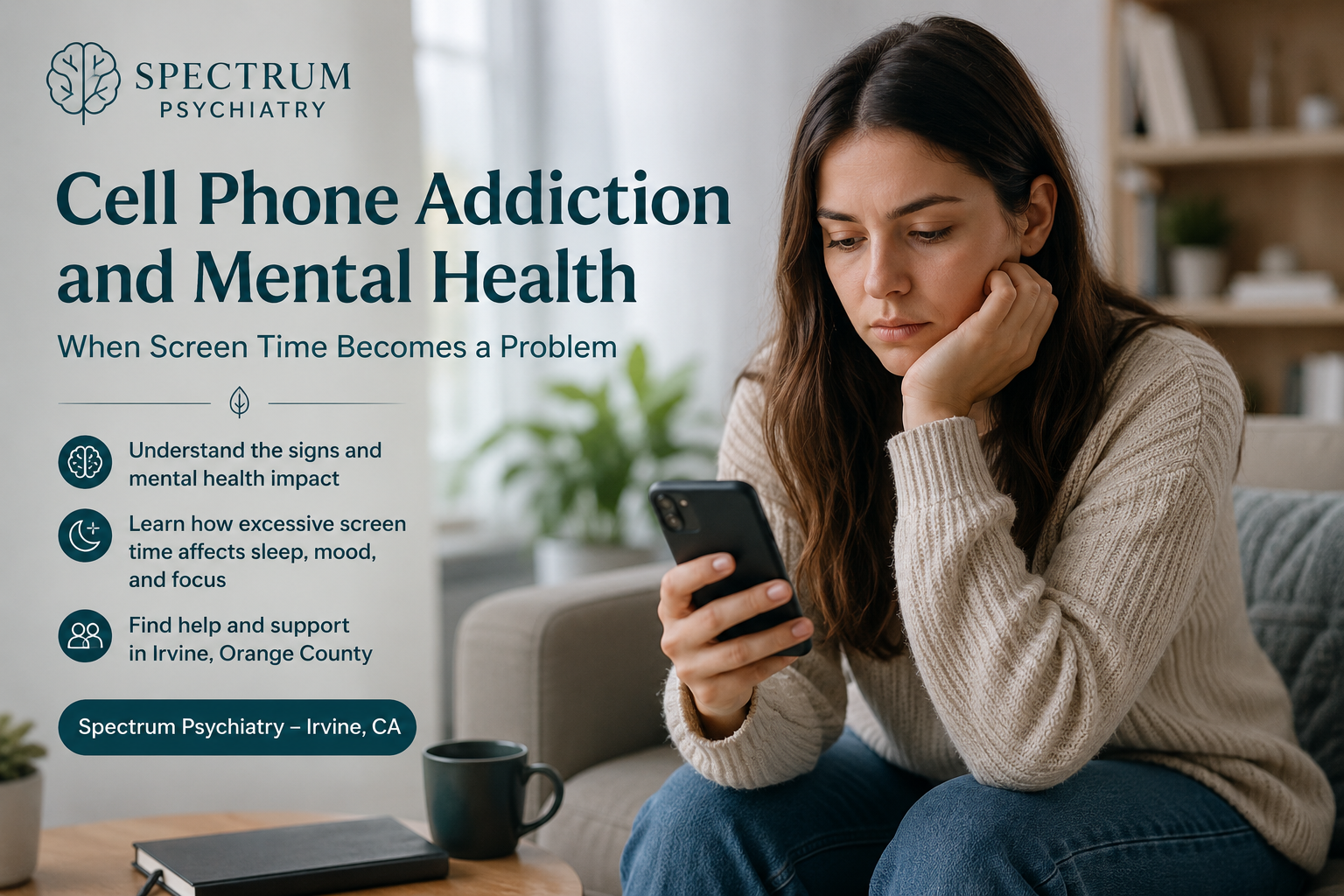
Cell Phone Addiction and Mental Health: When Screen Time Becomes a Problem
Cell phones are now part of daily life. People use them for work, school, communication, navigation, entertainment, banking, health information, and social connection. For many adults and teens in Irvine, Orange County, and across California, smartphones are no longer optional tools. They are deeply connected to how people organize their day and stay connected with the world.
But for some people, cell phone use can begin to feel difficult to control. A person may check their phone constantly, feel anxious when it is not nearby, lose sleep because of scrolling, or struggle to focus at work, school, or home. When phone use starts affecting mood, sleep, relationships, productivity, or emotional well-being, it may be time to look more closely at the connection between screen time and mental health.
At Spectrum Psychiatry in Irvine, Orange County, we understand that modern mental health concerns often involve technology habits, stress, anxiety, depression, ADHD symptoms, sleep problems, and lifestyle patterns. Cell phone addiction is not always about the phone itself. It is often connected to emotional regulation, avoidance, loneliness, anxiety, attention difficulties, and the brain's reward system.
What Is Cell Phone Addiction?
Cell phone addiction is commonly used to describe a pattern of compulsive or excessive smartphone use that feels hard to control and causes problems in daily life. Some professionals may refer to this as problematic smartphone use, digital overuse, screen dependence, or behavioral addiction-like phone use.
Not everyone who uses a phone often has an addiction. Many people in Irvine, Orange County, and California rely on smartphones for legitimate work, family, and safety reasons. The concern begins when phone use becomes repetitive, emotionally driven, hard to stop, and harmful to important areas of life.
For example, a person may intend to check one message but spend an hour scrolling social media. Another person may feel uncomfortable, restless, or irritable when their phone is not available. Someone else may repeatedly check notifications even during conversations, meals, work meetings, or bedtime.
Common Signs of Problematic Cell Phone Use
Cell phone addiction can look different from person to person. Some people mainly struggle with social media. Others are pulled into news, videos, online shopping, messaging, gaming, or constant checking. The pattern matters more than the specific app.
- Checking the phone repeatedly without a clear reason
- Feeling anxious, restless, or irritable when away from the phone
- Using the phone longer than intended
- Losing sleep because of scrolling or late-night screen use
- Difficulty focusing at work, school, or during conversations
- Ignoring responsibilities because of phone use
- Using the phone to escape stress, sadness, boredom, or anxiety
- Feeling guilty about screen time but continuing the same pattern
- Conflict with family, partners, or friends about phone use
- Checking notifications immediately after waking up
If several of these signs feel familiar, it may be helpful to evaluate how phone use is affecting your mental health. At Spectrum Psychiatry, patients in Irvine and Orange County often seek support not only for anxiety or depression, but also for daily habits that may be worsening those symptoms.
Why Cell Phones Can Feel So Addictive
Smartphones are designed to capture attention. Notifications, likes, messages, short videos, endless scrolling, and personalized recommendations can create repeated reward cycles. Each new alert or piece of content can provide a small sense of novelty, connection, entertainment, or relief.
This can become especially powerful when someone is stressed, lonely, anxious, depressed, or bored. The phone may become a quick way to avoid uncomfortable feelings. Over time, the brain can learn to reach for the phone automatically whenever emotional discomfort appears.
For many people in Orange County, busy schedules, work pressure, academic stress, social comparison, and constant digital access can make it difficult to disconnect. In a place like Irvine, where many adults, students, and professionals manage demanding routines, phone use can become both a tool and a coping mechanism.
Cell Phone Addiction and Anxiety
Anxiety and problematic phone use often reinforce each other. A person may check their phone to reduce anxiety, but the content they see may increase worry, comparison, urgency, or fear of missing out. This can create a cycle where the phone provides brief relief followed by more anxiety.
Social media can also contribute to anxiety by encouraging comparison. People may compare their appearance, career, family, relationships, lifestyle, or achievements to carefully edited online images. For some patients, this increases feelings of inadequacy or pressure.
At Spectrum Psychiatry in Irvine, we often help patients explore whether anxiety symptoms are being intensified by digital habits. Treatment may include identifying triggers, improving coping strategies, addressing underlying anxiety, and creating healthier routines around phone use.
You can learn more about our anxiety treatment services for patients in Irvine and Orange County.
Cell Phone Use, Depression, and Emotional Health
Excessive phone use may also be connected with depression. Some people use their phones to distract from sadness, low motivation, loneliness, or emotional pain. While distraction may help for a few minutes, it usually does not solve the underlying problem.
Long periods of scrolling can also reduce time spent on activities that support mental health, such as exercise, sunlight, sleep, meaningful conversations, hobbies, and in-person connection. When these healthy activities decrease, mood may worsen.
Depression can make it harder to stop scrolling because a person may feel too tired, unmotivated, or emotionally overwhelmed to do something else. This is why compassionate psychiatric evaluation can be helpful. The goal is not to shame the patient, but to understand what the behavior is doing for them emotionally.
Spectrum Psychiatry provides psychiatric care in Irvine, Orange County, and California for adults experiencing depression, anxiety, ADHD symptoms, sleep concerns, and stress-related conditions.
How Phone Use Affects Sleep
Sleep is one of the most common areas affected by cell phone addiction. Many people bring their phone to bed and continue scrolling long after they planned to sleep. Others wake up during the night and check messages, emails, or social media.
Late-night phone use can keep the mind active, increase emotional stimulation, delay bedtime, and make it harder to relax. Even when the content is not stressful, the habit of continuous scrolling can train the brain to stay alert instead of preparing for rest.
Poor sleep can then worsen anxiety, depression, irritability, concentration, appetite, and overall emotional resilience. In this way, phone use and sleep problems can become part of the same mental health cycle.
Cell Phone Addiction and ADHD Symptoms
People with ADHD symptoms may be especially vulnerable to problematic phone use. Smartphones provide novelty, quick rewards, constant stimulation, and rapid switching between tasks. This can feel engaging for a brain that struggles with sustained attention or boredom.
However, frequent phone checking can make attention problems worse. A person may start a task, check one notification, move to another app, and lose track of what they were doing. This can affect work, studying, household responsibilities, and relationships.
At Spectrum Psychiatry in Irvine, ADHD evaluations often include a discussion of digital habits, sleep, stress, work demands, and daily functioning. Treating ADHD is not only about medication. It may also involve structure, routines, behavioral strategies, and reducing distractions that interfere with daily life.
You can learn more about our ADHD treatment options for patients in Irvine and Orange County.
The Impact on Relationships and Family Life
Cell phone addiction can affect relationships in subtle but powerful ways. A partner may feel ignored when the other person is constantly checking their phone. Parents may feel guilty about being distracted around children. Friends may notice that conversations feel less present or meaningful.
In families, phone use can become a repeated source of conflict. One person may ask another to put the phone away, which can lead to defensiveness or frustration. Over time, this can create emotional distance.
Healthy phone boundaries can improve connection. Examples include phone-free meals, no-phone bedrooms, scheduled check-in times, and intentional in-person conversations. These changes may sound simple, but they can be difficult when phone use has become a primary coping strategy.
When Is Cell Phone Use a Mental Health Concern?
Cell phone use may be a mental health concern when it causes distress, worsens symptoms, or interferes with important parts of life. This does not mean the phone is the only problem. Often, it is a visible sign of deeper stress, anxiety, depression, ADHD, loneliness, burnout, or emotional avoidance.
Consider seeking professional support if phone use is affecting your sleep, work performance, school performance, relationships, mood, motivation, or ability to be present. It may also be time to seek help if attempts to reduce screen time repeatedly fail.
- You feel unable to control phone use
- You lose hours to scrolling despite wanting to stop
- Your phone use worsens anxiety or depression
- Your sleep is regularly disrupted by screens
- Your work, school, or relationships are being affected
- You use your phone to avoid emotions most days
- You feel panic or distress when separated from your phone
Practical Ways to Reduce Cell Phone Addiction
Reducing problematic phone use does not always require eliminating technology. For most people, the goal is healthier and more intentional use. Small changes can make a meaningful difference when they are repeated consistently.
- Keep the phone outside the bedroom at night
- Turn off non-essential notifications
- Use app limits for social media and video platforms
- Create phone-free times during meals or family time
- Do not check the phone immediately after waking up
- Replace scrolling with a short walk, reading, or journaling
- Use grayscale mode to reduce visual stimulation
- Schedule specific times for email and messages
- Practice noticing emotional triggers before reaching for the phone
These strategies can help, but they may not be enough if phone use is connected to untreated anxiety, depression, ADHD, trauma, insomnia, or other mental health concerns. In those situations, psychiatric care may help address the underlying symptoms that make phone use difficult to control.
How Spectrum Psychiatry Can Help
Spectrum Psychiatry provides personalized psychiatric care for adults in Irvine, Orange County, and nearby California communities. When patients are concerned about cell phone addiction, we look at the full picture rather than focusing only on screen time.
A psychiatric evaluation may explore anxiety, depression, ADHD symptoms, sleep patterns, stress level, work or school demands, substance use, relationship stress, medical history, and current medications. This helps identify what may be driving the behavior.
Treatment may include medication management when appropriate, therapy recommendations, lifestyle strategies, sleep improvement, behavioral changes, and support for healthier routines. The goal is not perfection. The goal is better functioning, emotional balance, and more control over daily habits.
If you are searching for a psychiatrist in Irvine, CA, Spectrum Psychiatry can help you better understand the relationship between technology use and mental health.
Cell Phone Addiction in Irvine and Orange County
People in Irvine and Orange County often live busy, high-demand lives. Professionals may feel pressure to respond to emails and messages quickly. Students may rely on phones for school, communication, and social life. Parents may use phones to manage family schedules, work, and daily responsibilities.
Because phones are useful, problematic use can be difficult to recognize. A person may tell themselves they need the phone for work or family, while also noticing that it is affecting their sleep, focus, or emotional health.
Spectrum Psychiatry serves patients in Irvine, Orange County, Newport Beach, Costa Mesa, Tustin, Lake Forest, Mission Viejo, Santa Ana, Laguna Hills, and surrounding California communities. Our goal is to provide thoughtful psychiatric care that fits the realities of modern life.
When to See a Psychiatrist
You may benefit from seeing a psychiatrist if cell phone use is connected to ongoing anxiety, panic symptoms, depression, irritability, ADHD symptoms, insomnia, emotional overwhelm, or difficulty functioning. A psychiatrist can help determine whether there is an underlying condition that needs treatment.
It is especially important to seek care if phone use is becoming a way to escape painful emotions, avoid responsibilities, or cope with symptoms that feel unmanageable. Professional support can help you build healthier coping tools and address the root causes.
Asking for help does not mean you have failed. Many people are struggling with digital overload. The important step is recognizing when a habit is affecting your quality of life and taking action before the cycle becomes more difficult to change.
Final Thoughts
Cell phone addiction is a modern mental health concern that can affect sleep, anxiety, depression, attention, relationships, and daily functioning. While smartphones are useful tools, they can become harmful when they begin controlling attention, emotions, and routines.
If you live in Irvine, Orange County, or nearby California communities and feel that phone use is affecting your mental health, Spectrum Psychiatry can help. A personalized psychiatric evaluation can help identify underlying concerns and create a plan for healthier digital habits and improved emotional well-being.

Medically Reviewed By
Cuneyt Tegin
Medical Reviewer
This article has been medically reviewed by Cuneyt Tegin to support accuracy, clarity, and alignment with current mental health education standards.
Last reviewed: June 2026
Related Articles
Mental Health Care in Irvine & Orange County
If cell phone use, anxiety, depression, sleep problems, or attention difficulties are affecting your daily life, Spectrum Psychiatry can help you explore personalized treatment options.
Contact Spectrum Psychiatry